AI for real estate agents: what’s in a tenancy application
In property management, AI for real estate agents usually starts with a paste: a tenancy application to summarise for the landlord, or a kind reply to an applicant who missed out. The application carries the lot. Date of birth, mobile, email, employer, the licence and Medicare card for the ID points, then the payslips and bank statements.
The Privacy Commissioner looked hard at that bundle in April 2026, finding the 2Apply platform had collected more than a tenancy application needs. Renters, she said, often lack real choice: hand over ID documents and payslips, or risk losing out on a home. Our guide to sensitive information in the files staff give AI goes through a payslip line by line.
In an invented tenancy application, measured with Nonimo 0.2.8, the mobile, email, date of birth, employer, BSB and account number came out as placeholders, and so did the Medicare card number. The weekly rent, net pay and rental reference stayed readable, because none of them names anyone. The driver licence number is picked up with the next version.
AI on the sales side: the contract, the deposit and one key
Once an offer is accepted, the sales side has paperwork of its own: the contract of sale, the vendor’s statement in Victoria, and the sales advice to both sides’ solicitors or conveyancers. Around it sit the purchaser’s contact details, the deposit into the trust account, and the land itself, by volume and folio or folio identifier, and by strata plan for an apartment.
Highlight the text and press the key: whatever Nonimo recognises turns into a placeholder right there on the Mac or Windows PC, before anything goes to ChatGPT, Claude or Copilot. The model answers using those placeholders, and Nonimo drops the real details back into its reply on your screen. How long OpenAI holds a paste is a separate question.
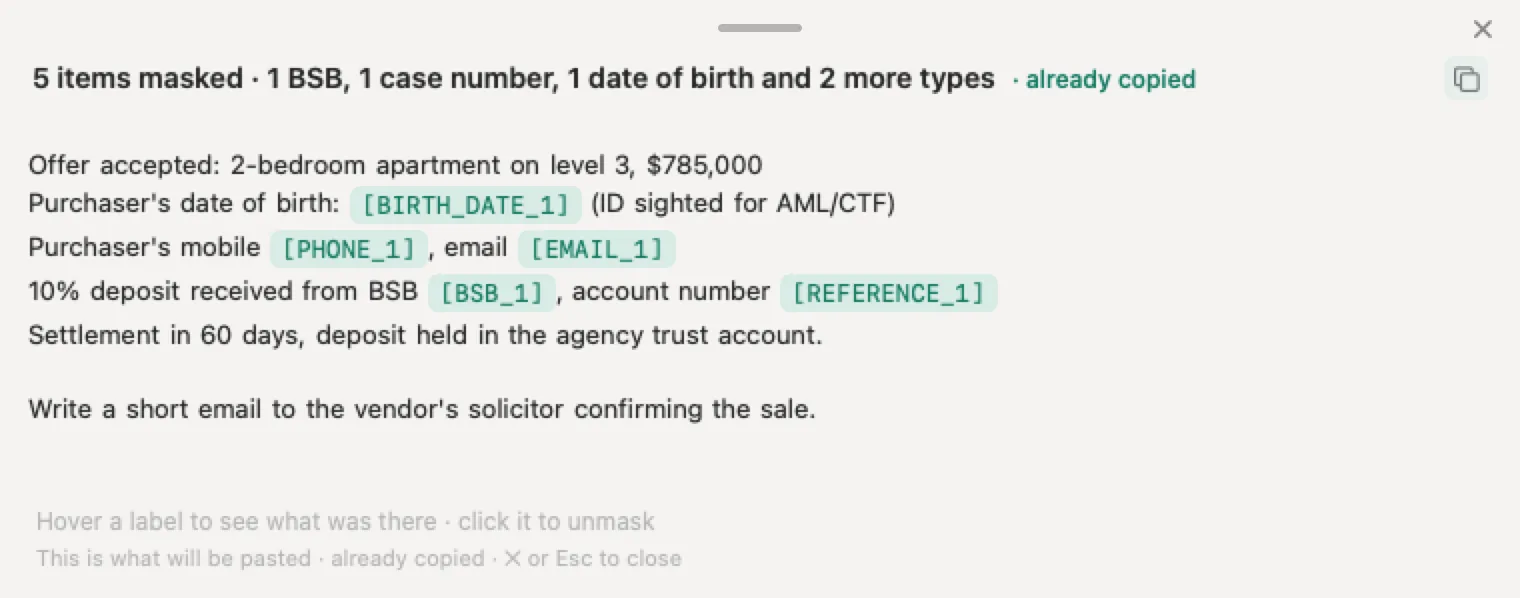
In the invented sales file below, the purchaser’s date of birth, mobile and email, and the BSB and account the deposit came from, reach the chat as placeholders. Price, deposit and settlement terms stay readable, so the email to the solicitor still gets written. The title reference and the strata plan number stay legible in this version, and Nonimo picks them up with the next version.
Before: what gets pasted
Offer accepted: 2-bedroom apartment on level 3, $785,000
Purchaser's date of birth: 30/02/1984 (ID sighted for AML/CTF)
Purchaser's mobile 0491 570 006, email buyer@example.com
10% deposit received from BSB 000-000, account number 000000001
Settlement in 60 days, deposit held in the agency trust account.

Write a short email to the vendor's solicitor confirming the sale.
After: what the AI receives
Offer accepted: 2-bedroom apartment on level 3, $785,000
Purchaser's date of birth: [BIRTH_DATE_1] (ID sighted for AML/CTF)
Purchaser's mobile [PHONE_1], email [EMAIL_1]
10% deposit received from BSB [BSB_1], account number [REFERENCE_1]
Settlement in 60 days, deposit held in the agency trust account.

Write a short email to the vendor's solicitor confirming the sale.
What the OAIC says about tenancy applications
The Privacy Commissioner’s determination on 2Apply, dated 1 April 2026, is about a RentTech platform, but agencies run all through it. It found the platform had collected personal information that was not reasonably necessary, and by unfair means, in a rental market whose power imbalance, she wrote, favours real estate agents, property managers and landlords.
Paragraph 10 is the one to read out at the next property management meeting: it encourages real estate agents to keep collection fair and limited to what is reasonably necessary. Paragraph 95 names identification documents, proof of income and details such as the number of names on a Medicare card. The decision also went to the real estate peak bodies.
None of that mentions AI. The OAIC’s AI guidance of 21 October 2024 does, and its best-practice advice is to leave personal information out of any generative AI tool the public can use. Whether the Privacy Act reaches a smaller agency depends on turnover and a few exceptions, which our guide to the Privacy Act and chatbots walks through.
AI in the agency and AML/CTF: what customer due diligence puts on file
Since 1 July 2026, an agency that brokers a sale or purchase provides a designated service under the AML/CTF Act. AUSTRAC is clear that a seller’s agent then has two customers in the one deal, the seller and the buyer, the buyer typically once the offer is accepted and the contract signed. The agency identifies both.
For an individual, AUSTRAC’s guide suggests full name, date of birth, residential address and a unique identifier such as a passport or driver’s licence number. The OAIC’s guidance for reporting entities, updated 28 August 2026, uses a real estate agency turning over $1.1 million as its case study: that customer due diligence now falls under the Privacy Act.
Nonimo treats an identification note like any other text. A number whose form leaves no doubt is swapped without asking; anything picked up from its label or place in the line is swapped too, but marked on screen with its reason, and one click puts it back. Placeholders are not de-identification, but on an invented note they covered the passport number, the birth date and the home address.
AI for real estate agents: price and how to start
Nonimo installs like any other program on a Mac or a Windows PC, from the download buttons at the head of this page. Nonimo’s free plan stops at a set number of words each month. Leave an email address on our licence page and a free licence file comes back that removes the cap until 31 January 2027, with no account to set up.
Plenty of tools sell AI for real estate agents, and Nonimo isn’t one of them: it sits in front of them. Each computer installs it on its own. Across the whole agency, IT can push out a browser extension, set by policy, that covers text without anyone pressing the key, as organisations explains. Nobody at the agency changes chatbot or learns a new screen.
Start at the rental desk, where applications land every day, then the sales admin who handles the file once an offer is accepted. The records the Privacy Act and the AML/CTF Act ask for stay the agency’s own, in its own systems. None of your text reaches us, and the short daily report the app sends us is described on the security page.
- Free today, on Mac and Windows
- With a monthly word allowance
- The free licence lifts it until 31 January 2027, no account needed
Questions agents and property managers ask
Can real estate agents paste a tenancy application into ChatGPT?
Nothing bans AI for real estate agents, but the OAIC's AI guidance of October 2024 advises, as best practice, leaving personal information out of generative AI tools anyone can sign up to. Its 2Apply determination encourages agents to collect only what is reasonably necessary. Nonimo swaps the date of birth, contact details, Medicare number and bank details it recognises for placeholders on the agency's machine before anything is sent.
Our agency turns over less than $3 million. Are we still caught?
More than it did before 1 July 2026. An agency turning over $3 million or less is generally exempt, but section 6E(1A) brings a reporting entity under the Act for what it does to meet its AML/CTF obligations, customer due diligence included. The OAIC's own case study is a real estate agency turning over $1.1 million. Other exceptions can apply too, such as operating a residential tenancy database.
What does AML/CTF customer due diligence collect from a buyer?
AUSTRAC's guide for individuals suggests collecting full name, date of birth, residential address and a unique identifier, such as a passport or driver's licence number. A seller's agent does this for the seller and, typically once the offer is accepted and the contract signed, for the buyer. Nonimo covers the passport number, the birth date and the address after its label, and the driver's licence number comes with the next version.
Is the title reference in a contract of sale covered?
It comes with the next version, together with the strata plan number. The contract of sale identifies the land by its title, and an apartment by its lot on the strata plan, so both turn up in almost every sales file. Until then they stay legible, and the after panel shows you every line before anything is sent, so you decide what goes.
Does Nonimo see our applicants' details?
No. The work is done on the agency's computer, and nothing from the text about your applicants reaches us, not even the terms on your own list. Each day we receive one usage count from the app: how much of the allowance is used, the version and the platform. It can't be switched off from inside the app, as our security page says, and there is no customer account.