AI for accountants: what’s in the rental schedule
In a practice it is rarely the whole return that goes into a chatbot. It is the rental schedule someone wants summarised, a BAS reconciliation that won’t balance, a client’s email about an ATO payment plan that needs a reply by five. Each carries the numbers that tie the work to a person or a business: TFN, ABN, the company’s ACN, the refund BSB and account.
The TPB has now said where that leaves a registered tax agent. Its guidance statement on AI, TPB(GS) 55/2026, issued on 22 July 2026, reads Code item 6 across to the chatbot. And for the number that matters most in your office it adds a line of its own: where TFNs are involved, “additional obligations under the Privacy (Tax File Number) Rule 2015 will apply”.
That is where AI for accountants has to start, and it is where Nonimo sits. It picks the client identifiers out of the selected text and puts placeholders in their place, on that computer, before anything is sent. What the Privacy Act adds on top, from offshore processing to the TFN rules, belongs with our guide to choosing a chatbot under the Privacy Act.
AI in the practice: what the chat gets after one key
Someone in the practice selects the text and presses one key. Nonimo replaces what it recognises with placeholders right there on the computer, Mac or Windows, and only after that does the text move on to ChatGPT, Claude, Copilot or whichever app is open. The model answers in placeholders, and the real details reappear in the reply on your screen, never on ours.
Where a labelled TFN, ABN or ACN checks out, it is swapped without asking. A BSB or an account number is swapped too, but in the open, with the reason shown and a click to undo it. You see every change in the app before the schedule goes anywhere, and the real numbers come back in the reply on your own screen.
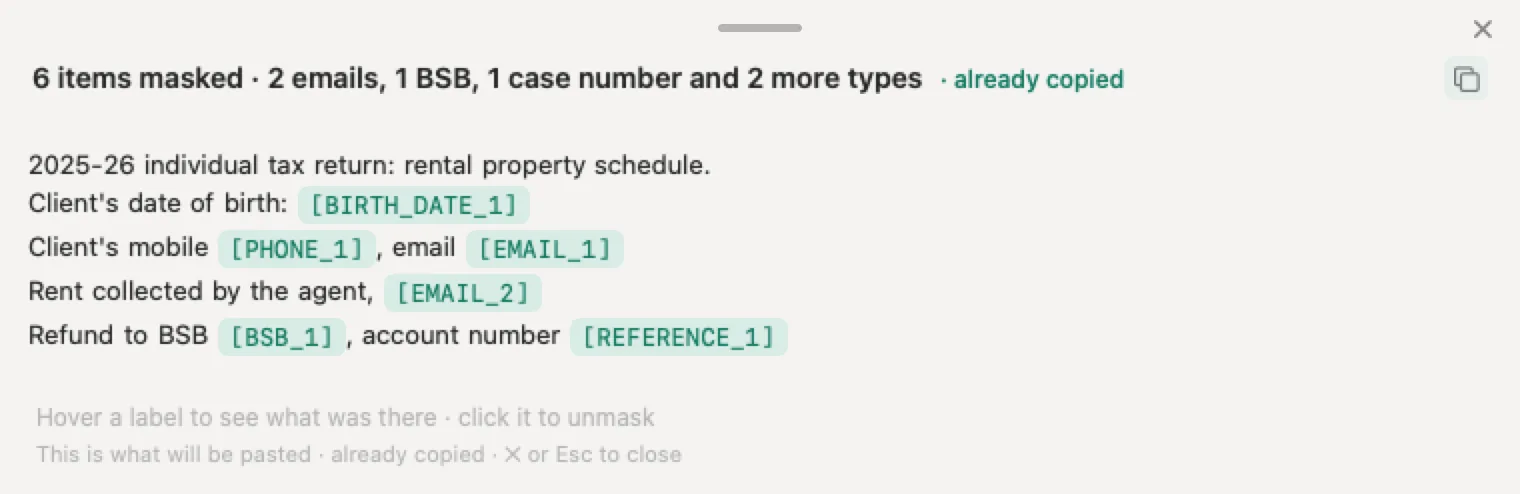
In the invented schedule below, everything that points at the client reaches the chat as a placeholder: the date of birth, the mobile, both email addresses, the refund BSB and the account number. Each gets its own numbered label, so the model can still tell the client’s email from the agent’s. Our security page says what the app reports daily.
Before: what gets pasted
2025-26 individual tax return: rental property schedule.
Client's date of birth: 30/02/1968
Client's mobile 0491 570 006, email client@example.com
Rent collected by the agent, rentals@example.com
Refund to BSB 000-000, account number 000000001
After: what the AI receives
2025-26 individual tax return: rental property schedule.
Client's date of birth: [BIRTH_DATE_1]
Client's mobile [PHONE_1], email [EMAIL_1]
Rent collected by the agent, [EMAIL_2]
Refund to BSB [BSB_1], account number [REFERENCE_1]
What the TPB says about AI for accountants and tax agents
The TPB’s guidance statement is written for registered tax agents and BAS agents, which it calls tax practitioners together. Under Confidentiality it says they “must obtain permission from each client prior to divulging client information to a third party”, and that this can include entering client information into AI tools, depending on how those tools are configured and used. That permission can come through a signed engagement letter.
That must comes from Code item 6, which already stops you disclosing a client’s affairs to a third party without permission. The statement also recommends telling the client “to whom and where the disclosure will be made, where data will be stored and whether AI tools may be used”. For the placeholders, the answer is short: they never left the machine.
The TPB ties permission to what you enter and how the tool is set up, and what you enter is what Nonimo changes. The identifiers it recognises reach the chatbot as placeholders, while the question you are asking arrives intact. For what happens to the rest of the text once OpenAI has it, read does ChatGPT save your data.
AI for accountants: TFNs, due diligence and the paper trail
The TFN is where the TPB gets most specific, pointing to the Privacy (Tax File Number) Rule 2015. Nonimo replaces a TFN without asking when “TFN” or “tax file number” sits in front of it and the check digit adds up. The placeholder it leaves, [TFN_1], tells the model what kind of number stood there without giving the number away.
Under due diligence the TPB asks you to review AI tools “to ensure information will be kept secure and that the requirements of the Privacy Act 1988 (Cth) (Privacy Act) are met”. What you’ll want to know about us fits in two lines, both on the security page: detection happens on the machine, and the daily count carries none of your text.
The line about documenting is a different matter. Under Competency the TPB says practitioners “should verify and review AI generated content”, adding that “Each of these steps should be documented”, with sections 30 and 40 of the Determination behind it. That is about checking what comes back, and it stays with the practice.
AI for accountants: price and how to start
The application runs on Mac and on Windows, and the downloads are at the top of this page. Nonimo’s free plan stops at a set number of words each month. Leave an email address on our licence page and a free licence file comes back that removes the cap until 31 January 2027, with no account to set up.
Every computer can install it on its own, with no IT provider booked. For the whole practice, IT pushes out a browser extension by policy that covers text unasked and, where the practice decides, blocks; hello@nonimo.ai starts that. Staff keep using ChatGPT, Claude or Copilot as they already do, in the browser they already have open.
A practice can start at the desks where staff already draft in ChatGPT or Copilot: install the app, select the next schedule, press the key and read the result before it is sent. Nothing needs configuring first, and the real numbers come back in the reply on that same computer, never on ours.
- Free today, on Mac and Windows
- With a monthly word allowance
- The free licence lifts it until 31 January 2027, no account needed
Questions tax agents ask
Can accountants use ChatGPT?
Yes, and the TPB says so in plain terms. Its guidance statement calls AI tools, “when used appropriately”, a significant opportunity for tax practitioners, while making clear you stay responsible for the services you provide. Nonimo handles one part of using it appropriately: the client identifiers it recognises, such as a labelled TFN, are swapped for placeholders on your computer before anything is sent.
If Nonimo covers the TFN, do I still need the client's permission?
That is a judgement for you, and possibly your adviser. The TPB ties the permission question to what you enter and to how the AI tool is configured and used, and suggests practitioners seek their own advice where they are unsure. Nonimo changes what you enter by taking out the identifiers it recognises, but it doesn't answer the permission question and doesn't record the client's consent either.
Does TPB(GS) 55/2026 apply to BAS agents?
Yes. The guidance statement is written for registered tax agents and BAS agents, which it refers to together as tax practitioners, so a bookkeeping practice doing BAS work sits under it in the same way. Nonimo works the same for both: the ABN, TFN or BSB in a reconciliation someone pastes is swapped for a placeholder on that computer, where it is recognised.
What about CPA Australia and CA ANZ?
The TPB points members back to their own code. It notes that APES 110 applies to members of CA ANZ, CPA Australia and the IPA, and refers to the APESB's technical alert on the ethical use of AI. The guidance statement itself names no AI product, ours included, so Nonimo is a safeguard you choose, not one any of these bodies has approved.
Does the TPB want AI use documented?
For checking what the AI produces, yes, though it says should rather than must. Under Competency it asks practitioners to verify and review AI generated content and says each of these steps should be documented, pointing to sections 30 and 40 of the Determination. The app keeps no log of what it changed, and a practice-wide dashboard only counts by category, so that documentation has to come from the practice itself.