AI for law firms: what’s in the brief to counsel
Nobody pastes the whole file into a chatbot. What goes in is a slice: two paragraphs of a brief to counsel that need tightening, the chronology from an affidavit, an intake form a paralegal wants turned into a table. When the whole document does have to go in, drop it on the Nonimo window and a masked copy comes back next to the original, a Word file as a Word file. And the slice is where the numbers sit, next to a name: tax file number, Medicare number, ABN, ACN, date of birth.
For a principal that isn’t a question of style. Rule 9 of the Conduct Rules, on confidentiality, is yours, and so is rule 37 when someone you supervise does the pasting. The Law Society of NSW put the consequence in one line in its guide updated January 2026: client material in a public chatbot is “akin to putting it in the public domain”.
That gap is the first thing AI for law firms has to close, and it is where Nonimo sits. It finds the client identifiers in the selected text and swaps them for placeholders on that computer, before anything is sent. Which chatbot the Privacy Act lets you use at all is a separate question, covered in our guide to choosing an AI tool under the Privacy Act.
AI in a law firm: what reaches the chat after one key
Select the text and press one key. Nonimo swaps what it recognises for placeholders on the computer, and only then does the text go to ChatGPT, Claude, Copilot or any other app, on Mac or Windows. The model works with the placeholders, and Nonimo puts the real details back into its reply. What the app does send us is on our security page.
A labelled number that checks out is replaced without asking. Other details, such as a file reference or a date after “born”, are replaced too, but in the open, with the reason shown and each change undone with a click. The solicitor sees every placeholder before the brief leaves the computer, and the real details come back in the reply on that same screen.
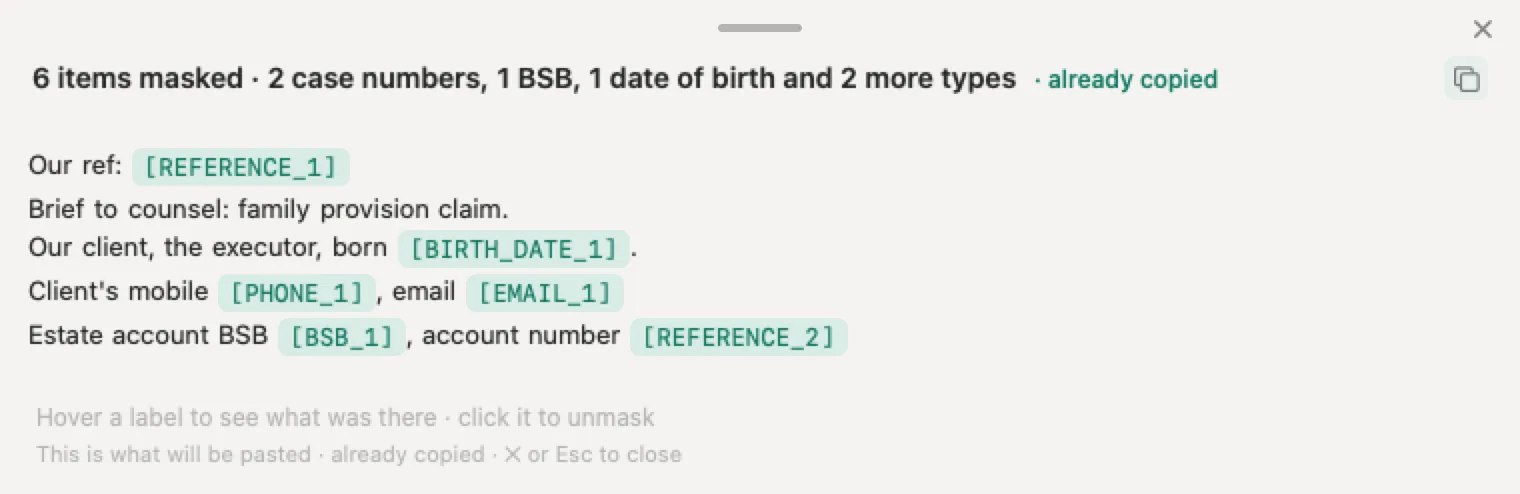
In the invented brief below, every line that leads back to the client reaches the chat as a placeholder: the file reference, the date after “born”, the mobile and email, and the estate’s BSB and account number. The model can still tighten the brief, because each placeholder tells it what kind of detail stood there.
Before: what gets pasted
Our ref: 00000
Brief to counsel: family provision claim.
Our client, the executor, born 30/02/1968.
Client's mobile 0491 570 156, email executor@example.com
Estate account BSB 000-000, account number 000000001
After: what the AI receives
Our ref: [REFERENCE_1]
Brief to counsel: family provision claim.
Our client, the executor, born [BIRTH_DATE_1].
Client's mobile [PHONE_1], email [EMAIL_1]
Estate account BSB [BSB_1], account number [REFERENCE_2]
What the Law Society of NSW says about AI in law firms
The Law Society of NSW doesn’t rule generative AI out. Its guide opens a decision tree with “Is any confidential or sensitive information involved?”, and where the answer is yes, it allows the tool “provided that” that information “is not disclosed externally via use of the generative AI tool” (page 8). That condition is the one the key is built around.
Paying for the business version doesn’t move the line. The same guide says a solicitor’s measures are no different “whether it’s a publicly available system like ChatGPT, or a commercial proprietary system commissioned for in-house use” (page 3). For what a Microsoft licence does and doesn’t settle, read whether Copilot is safe for confidential information.
That leaves two kinds of safeguard doing different jobs. The contractual one lives in your agreement with the AI vendor and covers whatever you do send. The technical one is ours and stays on your side of the screen: the identifiers Nonimo swaps out never reach the vendor at all. One doesn’t replace the other.
AI for law firms and the seven societies’ checklist
In February 2026 seven law societies, covering Queensland, Victoria, South Australia, Western Australia, the ACT, the Northern Territory and Tasmania, released a joint AI selection and use checklist, written “to assist small and mid-tier firms”. It is the list a firm works through when choosing an AI tool, and several questions are about the vendor rather than the model. Its annexures include a model disclosure for clients.
Two of those lines speak directly to Nonimo. It says “Any promises the licensee/vendor makes about confidentiality need to be examined in light of the other providers involved” (page 9), and warns that “confidentiality assurances may no longer be credible” as US policy shifts (page 5). Not one word of your text reaches us, so there is no promise of ours to examine.
Under Record Keeping, on page 7, the checklist asks “What records of the system use (including prompts and responses) is possible?”, and for Nonimo the answer is short: it shows each change as you paste and keeps no log of it, and a firm-wide dashboard sees only counts. The practice keeps that record, as it does for other tools. More on our security page.
AI for law firms: price and how to start
There is a desktop app for Mac and one for Windows, both downloadable from the top of this page. Nonimo’s free plan stops at a set number of words each month. Leave an email address on our licence page and a free licence file comes back that removes the cap until 31 January 2027, with no account to set up.
Each computer installs the app like any other program. A firm with several desks has IT roll out the browser extension by policy, which covers text unasked and, where the firm decides, blocks; hello@nonimo.ai sets it up. Staff keep using ChatGPT, Claude or Copilot as they already do, in the browser they already have open.
A firm can start at the desks where ChatGPT or Copilot is already open on client matters: install the app, select the next paragraph of a brief, press the key and read the AFTER before it goes. Nothing needs configuring first, and the identifiers come back in the reply on the solicitor’s own screen.
- Free today, on Mac and Windows
- With a monthly word allowance
- The free licence lifts it until 31 January 2027, no account needed
Questions solicitors ask
Can law firms use ChatGPT?
Yes, within limits the profession has written down. The Law Society of NSW opens its decision tree with “Is any confidential or sensitive information involved?”, and where the answer is yes, it makes generative AI conditional on that information not being disclosed externally (page 8). Nonimo takes the client identifiers it recognises out of the selected text on your computer, before the prompt goes anywhere.
Is ChatGPT Enterprise or Copilot enough for a law firm?
Not on its own, going by the Law Society of NSW. Its guide says a solicitor's measures are no different for a public system like ChatGPT or a commercial one commissioned in-house (page 3), and the joint checklist says vendor confidentiality promises must be examined in light of the other providers involved (page 9). Nonimo adds a technical safeguard that works on the firm's own computers.
Does a law firm need a PIA before staff use AI?
The seven societies' checklist says yes. A Privacy Impact Assessment must be conducted before deploying the system: a statutory obligation for entities regulated by the Privacy Act and a professional duty for everyone else (page 5). Nonimo doesn't write your PIA, but it gives you a clear line for it: detection runs on the machine, and none of your text comes to us.
What does the AI vendor see after Nonimo has run?
The placeholders where Nonimo made a change, and everything else as it was written. The checklist confines even its public model exception to tasks such as research and structuring documents, with “no identifying particulars” in prompts or uploads (page 10). That is why Nonimo shows you the result before you send, so a solicitor can judge what the facts still give away.
What do we write in the Record Keeping line of the checklist?
That Nonimo keeps no record of what it changed. The checklist asks what records of system use, prompts and responses included, are possible, and whether they could go on the client file or to a Court (page 7). Nonimo shows every change as you paste, and a firm-wide dashboard gets counts by category, never a prompt.