ChatGPT and HIPAA at the front desk: what a referral letter carries
No one on your staff pastes a whole chart into a chatbot. They paste a slice: the referral letter to cardiology the doctor wants by five, a prior authorization appeal, a reply to a portal message, a discharge summary rewritten in plain English for the family. The top of every slice holds the lines that point to one patient, and on older intake forms that includes the Social Security number.
Name, date of birth, phone, email, Social Security number, medical record number: each of those is on the list of eighteen identifiers in the Privacy Rule’s safe harbor at §164.514(b)(2), where the MRN is letter (H). Our guide to HIPAA and AI tools goes through the whole list. This page is about the few seconds before the paste.
The business associate agreement with your AI vendor settles what the vendor owes the practice. It says nothing about what a medical assistant types into a personal account open in the next tab at 4:45 on a Tuesday. That decision is made at the workstation, by whoever is sitting there, and the workstation is where Nonimo does its work.
HIPAA and ChatGPT: what reaches the chat after the key
Your staff member selects the text and presses one key. On that Mac or Windows workstation, Nonimo swaps what it recognizes for placeholders, and only then does the text go to the chat. The AI writes its reply around the placeholders, and Nonimo puts the real details back in. What does and does not leave the machine is set out on our security page.
How openly the swap happens depends on the proof. A number whose check digit adds up is replaced without a question. A value recognized by the label in front of it, or by where it sits on the form, is replaced too, but in plain view, with the reason in one line and an undo for each item.
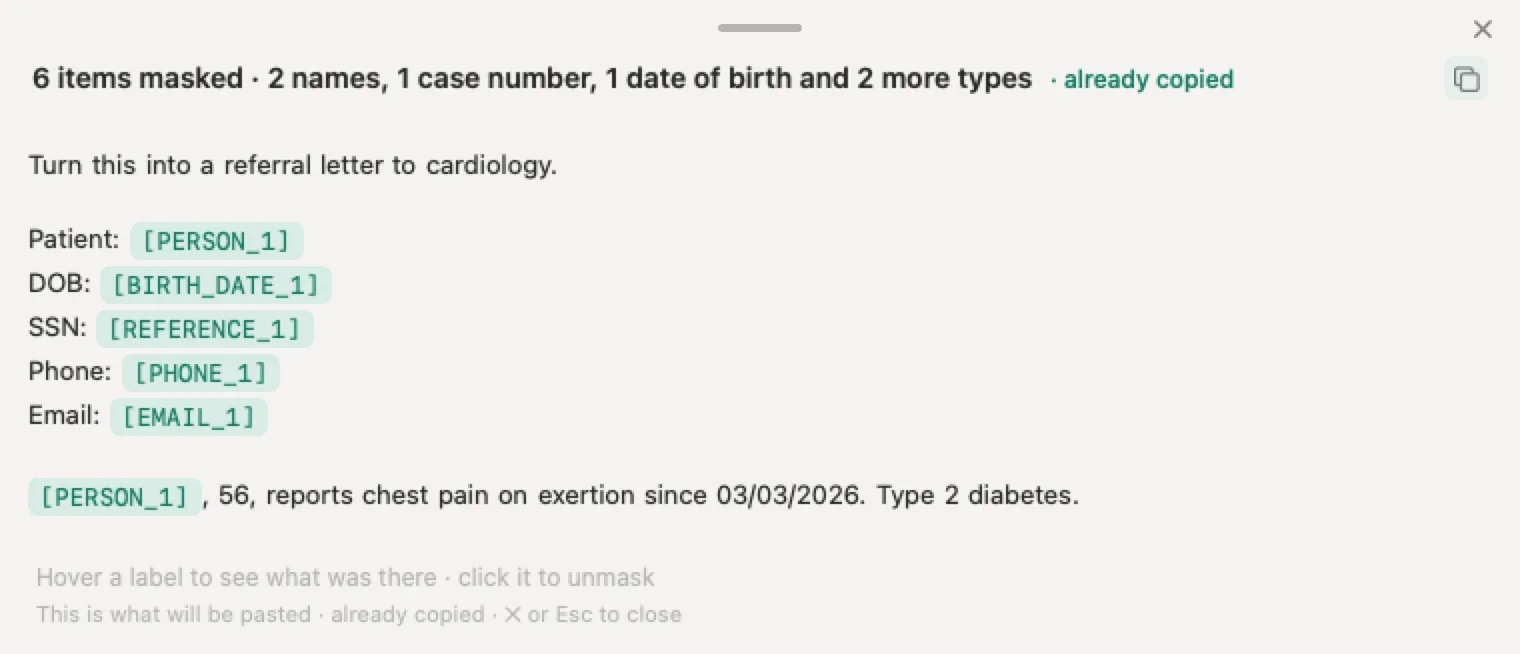
That is why the example beside this masks a Social Security number that cannot exist: no SSN starts with 000, but it sits behind “SSN”, and the label is the proof. The date of birth behind “DOB” goes the same way, in plain view. The patient keeps a single placeholder from the header to the sentence, so the AI reads one patient.
Before: what gets pasted
Turn this into a referral letter to cardiology.

Patient: Jane Doe
DOB: 1970-02-30
SSN: 000-00-0001
Phone: 202-555-0100
Email: jdoe@example.org

Jane Doe, 56, reports chest pain on exertion since 03/03/2026. Type 2 diabetes.
After: what the AI receives
Turn this into a referral letter to cardiology.

Patient: [PERSON_1]
DOB: [BIRTH_DATE_1]
SSN: [REFERENCE_1]
Phone: [PHONE_1]
Email: [EMAIL_1]

[PERSON_1], 56, reports chest pain on exertion since 03/03/2026. Type 2 diabetes.
Is ChatGPT HIPAA compliant? What the Privacy Rule actually says
The sentence quoted here is why “is ChatGPT HIPAA compliant?” has no yes or no answer. HIPAA attaches to the information, not to the tool that receives it. Health information that meets §164.514(a) and (b) stops being individually identifiable, and the safe harbor route reaches that point by removing the eighteen identifiers and having no actual knowledge that the rest points back to the patient.
The safe harbor asks for removal and nothing more on paper. It is the other route, expert determination, that requires the expert to document “the methods and results of the analysis that justify such determination” under §164.514(b)(1)(ii). For a practice relying on the safe harbor, the duty is to take the identifiers out, and taking them out before the text leaves the workstation is the part Nonimo handles.
Nonimo does not turn a note into de-identified health information: it takes out the identifiers it recognizes, and the rest of the note goes as written. The clinical detail, such as the symptoms and the question for the specialist, still arrives, because that is what the AI is there to help with. The guide on redaction explains what removal does and does not change.
ChatGPT in a HIPAA practice: price and getting started
Nonimo is a desktop app for Mac and Windows. Nonimo’s free plan stops at a set number of words each month. Leave an email address on our license page and a free license file comes back that removes the cap through January 31, 2027, with no account to set up. The app itself installs from the buttons at the top of this page.
With several workstations, each installs the app, or IT deploys the browser extension by policy, which covers text unasked and, where the practice decides, blocks. Either way the work happens on the workstation, before the text reaches any assistant at all. A practice can start at the front desk, where referral letters and portal replies are written, and add workstations from there.
The question your Privacy Officer will ask next is what reaches us. Not one word of your text does, and our security page lists everything the app sends. No record of the changes is kept by the app, and the conversation it needs to restore the details stays encrypted on that workstation’s own disk.
- Free today, on Mac and Windows
- With a monthly word allowance
- The free license lifts it through January 31, 2027, no account needed
Questions from the practice
Is ChatGPT HIPAA compliant?
Not as a product, because HIPAA does not grade products; it governs what a covered entity does with protected health information and which vendors it signs agreements with. Which ChatGPT plans come with a business associate agreement, and what each agreement carves out, is in our guide to HIPAA and AI tools. Nonimo works on the other side of the agreement: it takes the identifiers it recognizes out of the text on your workstation first.
Do we still need a business associate agreement if we use Nonimo?
Yes, as long as what you send still counts as PHI, and after Nonimo it usually will. Section 164.502(e) of the Privacy Rule lets PHI go to a business associate once the practice has satisfactory assurance that it will be safeguarded, and that assurance is a contract. Nonimo is a technical control on your own machines, so it sits next to the agreement rather than replacing it.
We already pay for Microsoft Purview. Doesn't that cover ChatGPT?
Not for ChatGPT Enterprise: Microsoft's own capability table marks data loss prevention there as not supported. Purview is not a key on the front desk computer, and that is where Nonimo runs. The medical assistant selects the referral letter, presses the key, and the patient's name, date of birth and SSN are replaced before the paste, whichever AI tab is open.
Does Nonimo give us a record we could show OCR?
The safe harbor in §164.514(b)(2) does not ask for one; only expert determination does, under (b)(1)(ii), and that analysis belongs to the expert, not to a tool. The app logs nothing about the masking, and a practice-wide dashboard only counts by category. What the app does hold is the conversation itself, encrypted on the workstation disk, so it can put the real details back into the reply.
Can Nonimo see our patients' information?
No. Detection runs on the Mac or Windows workstation where the text was selected, and not one word of it is sent to us. Once a day the app sends a usage count with the share of the monthly allowance used, the version and the platform, with no text in it and none of the terms you add yourself. The security page lists every field in that count.