AI disclosure language for engagement letters: sample clause
· Updated · Written and maintained by Joaquín Trapero, Nonimo
Before you draft AI disclosure language for engagement letters, settle whether the client has to be told at all. No ABA Model Rule says to tell every client you use AI. The ABA’s own reading is that it depends on the facts of the matter. That is the easy half.
The hard half is that three ordinary facts turn the answer into yes, and the first one shows up whenever these tools touch real client work. Client information goes into the tool. The fee depends on the tool. Or the client asks, or its outside counsel guidelines require it. Any one of the three means the client has to be told.
This guide takes the three triggers one at a time and sets four state bars side by side. Then it separates telling the client from asking for consent, which are two different jobs.
After that comes the clause itself: a disclosure paragraph, a client information paragraph in two versions, a billing paragraph and a consent block. CPA firms get a paragraph of their own, built around section 7216. For the rest of what AI changes inside a firm, see Nonimo for law firms.
Three facts that make telling the client a duty
Start with Model Rule 1.4, the communication rule. It requires a lawyer to “reasonably consult with the client about the means by which the client’s objectives are to be accomplished.” It also requires explaining matters well enough for the client to make informed decisions about the representation. A tool that drafts, summarizes or reviews is one of those means. But not every means needs a conversation.
The ABA applied the Model Rules to generative AI in Formal Opinion 512, issued July 29, 2024. The privilege and redaction guide walks through it duty by duty. For the engagement letter, the opinion matters in three places.
Will client information go into the tool?
YesRule 1.6: get the client's informed consent before it goes in.
NoGo to the next question.
Will the tool change what the client pays?
YesRule 1.5: explain the basis of the charge in the letter.
Has the client asked, or do its outside counsel guidelines call for it?
YesRule 1.4: tell the client.
None of them: telling the client is still allowed, and the engagement letter is the place.
When none of the three applies, you can still tell the client. The engagement letter is where the ABA and several state bars point, and the sections below take each trigger in turn.
Client information going into the tool
Model Rule 1.6, the confidentiality rule, protects everything connected with the representation. That information goes out only with the client’s informed consent, implied authorization or a listed exception. For tools that can learn from what they are given, the ABA says informed consent comes before any of it goes in. California and Florida reach similar ground by their own routes.
That is why the sentence about data drives the rest of the clause. If client information will go into a tool, the letter can’t just inform. Somewhere, it has to ask. The ChatGPT data guide shows, plan by plan, which consumer and business plans learn from what you type.
When the fee changes because of AI
Rule 1.5(b), the fee rule, already requires the basis of the fee to be communicated before or soon after the representation starts, preferably in writing. The ABA applies that directly. Before charging a client for a generative AI tool or service, explain the basis for the charge. A firm that bills hourly bills the time actually spent, including prompting and checking. It bills nothing for the time the tool saved.
Texas put that last point bluntly in Opinion 705, issued in February 2025: a lawyer may not charge hourly fees for the time saved by using the program. If a tool will show up on an invoice, even as a per use expense, the engagement letter is the natural place to say so.
When the client asks, or its outside counsel guidelines do
The third trigger is the simplest. If a client asks how the work was done, or whether AI was used, the lawyer has to answer. If the engagement agreement or the outside counsel guidelines require disclosure, the client has to get it. California’s 2026 guidance adds that a lawyer must follow client instructions or guidelines that restrict or limit AI in the representation.
A corporate client may already have written those instructions, and they may be stricter than anything below. Telling a judge is a separate duty with rules of its own, covered in the court filings guide. This guide stays with the client.
California, Florida, New York and Texas on telling the client
Your own state’s rules and opinions are the ones that bind you, and they don’t all say the same thing. We read four of them in full for this guide. Here is how they line up on the three questions an engagement letter has to answer.
| Bar and document | Telling the client | Client information going in | Fees |
|---|---|---|---|
| California, COPRAC Practical Guidance, 2026 revision | Must consider disclosing the intended use, how, and its risks and benefits | Not into a tool with material risks, absent informed consent | Fee agreement explains AI costs; no markup without informed written consent |
| Florida, Ethics Opinion 24-1, 2024 | No general disclosure duty stated | Informed consent recommended for a third party tool; not required if nothing confidential goes out | Tell the client, preferably in writing, before charging AI costs |
| New York, NYSBA Task Force report, 2024 | Consider saying so in the engagement letter, with the client’s acknowledgment | Even with consent, get assurances from the provider | Any surcharge stated in the engagement letter |
| Texas, Opinion 705, 2025 | Consider informing clients of the risks | If unsure of the tool, no confidential input without consultation and consent | No hourly billing for time saved |
Sources: the four documents in the source list below, read on September 24, 2026.
None of the four is rule text. Florida prints on its opinion that advisory ethics opinions are not binding. The New York report is a task force’s recommendations to its bar’s House of Delegates. Still, they are the published reading of the rules in those states, and the table shows how much of the work lands on the letter. What a firm policy looks like at the keyboard is on the law firm page.
New York printed a sample provision, and it is silent on data
The House of Delegates approved the NYSBA report on April 6, 2024. The report suggests the engagement letter tell the client these tools may be used in the representation, and ask the client to acknowledge it. Its Appendix C supplies a sample. The sample covers research and drafting, efficiency and the lawyers’ judgment. On the client’s information it says nothing: not where it goes, who holds it or for how long.
It doesn’t mention fees either. Yet the same report, in its guidance on fees, says any surcharge for a tool should be clearly stated in the engagement letter. The sample also predates the ABA opinion by almost four months. Used on its own today, it is exactly the kind of general provision the ABA later said does not amount to informed consent.
Texas printed three samples, and one mentions client data
The State Bar of Texas practice management program published sample AI disclosures for attorney client contracts in 2025, with a note to tailor them to the firm and the client. There are three. All of them say the tools support research and drafting under attorney supervision. None of them mentions fees.
Only the second sample commits to anything about data. The firm will not enter identifiable client information into a system that stores or uses data for training, unless the system is deployed in a private or secure environment. That is a real promise. But the client can’t tell what a private or secure environment is, and the firm may not be able to prove which one it used. The data sentences below try to close both gaps.
Notice versus consent: two jobs for one engagement letter
The ABA takes the two questions in a fixed order, and your letter should too. First comes the confidentiality rule: will information relating to the representation go into the tool, and if so, has the client given informed consent? Only where that rule does not require consent does the analysis move to the communication rule. There the question is whether disclosure is still owed.
| Notice (Rule 1.4) | Informed consent (Rule 1.6) | |
|---|---|---|
| What it does | Tells the client how the work gets done | Asks the client’s permission first |
| When it is owed | The client asks, guidelines require it, or it bears on fees | Client information will go into the tool |
| Same for every client? | Yes, one paragraph for the whole client list | No, it is tied to a particular tool and matter |
| What it covers | The tasks, and a lawyer’s review of the output | Why the tool, the risk, the information involved, the benefit |
| Signature | The letter’s own; New York suggests an acknowledgment | A paragraph and signature line of its own |
| When it goes in | With the engagement letter | Before any client information goes in |
Sources: ABA Formal Opinion 512, pages 7 to 9; NYSBA Task Force report, page 57.
A disclosure paragraph can be the same for every client, because the communication rule is met by explaining the means. Consent can’t. The ABA says a general, boilerplate authorization in an engagement letter does not produce informed consent. So if the letter is where you ask, the request needs specifics and a signature of its own.
What the client has to hear before saying yes
The ABA lists what informed consent needs here. You give your best judgment about why the tool is being used and how large the risk is. You say what kinds of client information are involved, and how others might use that information against the client. And you explain clearly how the tool benefits the representation. The ABA also asks you to explain the risk that later users of the tool could reach the information.
Texas and Florida get to the same place by their own paths. Texas says a lawyer who is not reasonably satisfied the program will keep information confidential should not put any in without consulting the client and getting consent. Florida recommends consent before a third party program sees anything confidential. It says consent is not required when nothing confidential goes to a third party.
Most careful firms end up in the middle column, and it is the one most often misread. Replacing names and numbers before a prompt still leaves the facts of the matter in it. The confidentiality rule covers those facts whatever their source. Our privilege guide explains why stripping identifiers and keeping confidences are separate questions. The masking guide explains why reversible placeholders fall short of anonymization.
AI disclosure language for engagement letters, paragraph by paragraph
The language below is written for a US engagement letter, or for the terms of engagement a firm attaches to it. It fits best after the confidentiality paragraph and before the fee terms. Brackets mark decisions the firm has to make. A bracket left in the signed copy is a commitment nobody defined.
There are four parts. The disclosure paragraph goes to every client. The client information paragraph comes in two versions, and the firm uses the one that matches how it actually works. Then come a billing paragraph and a client instructions paragraph, plus a consent block wherever version B is used. What staff may do internally belongs in the firm’s policy, and the AI policy template saves you writing it from scratch.
The disclosure paragraph and the two data sentences
The first card below goes in every letter. Its bracketed list is what California’s 2026 guidance has in mind when it tells lawyers to consider disclosing how the technology will be used. The verification sentence restates the duty every opinion in the table puts on the lawyer. Keep the list current. If the firm starts using the software for a task that isn’t on it, amend the paragraph for new engagements rather than letting the letter drift.
Artificial intelligence. In representing you, the Firm may use generative artificial intelligence software for [legal research, preparing first drafts of documents and correspondence, summarizing depositions and document productions, and proofreading]. The software assists our lawyers. It does not replace their judgment. A lawyer on your matter reviews and verifies anything it produces before the Firm relies on it or sends it to you, to a court or to anyone else. The Firm remains professionally responsible for all work on your matter, however it was prepared.
Before text from your matter is used with this software, the Firm removes from it the information that identifies you or anyone else, on computers the Firm controls. That includes names, Social Security numbers and other government identifiers, dates of birth, addresses, telephone numbers and financial account numbers, which the Firm replaces with placeholders. The Firm then reviews the remaining text for details that could identify you or anyone else. The list matching placeholders to the removed information does not leave the Firm. The software receives the rest of the text, including facts about your matter, and the Firm treats that text as your confidential information.
With your consent, the Firm would use [name and plan of the software], provided by [company], with documents and information from your matter, including confidential and personal information about you and others. The purpose is to [review and summarize the document production faster and at lower cost to you than manual review]. The provider's terms with the Firm require it to keep that information confidential, [prohibit it from using the information to train its models,] require it to notify the Firm of a security breach or of a subpoena or other legal demand for the information, and [require deletion within [period]].
Even with those terms, the information would be held outside the Firm. A breach at the provider, a legal demand served on it or a failure in its controls could expose it to others. [Describe any risk particular to this matter.] The Firm will not use the software with your information unless you consent below. You may withdraw consent in writing at any time for work not yet done.
Compare version A with the Texas sample that keeps identifiable client information out of systems that train on it, unless the system sits in a private or secure environment. That promise depends on the vendor’s setup, which the client can’t inspect. Version A depends on a step the firm performs itself, so the firm can know whether it kept its word.
The last sentence of version A is there because of the confidentiality rule. That rule protects everything connected with the representation, wherever it came from, and facts without names are still connected with it.
Florida excuses consent only where nothing confidential goes to a third party, and a masked prompt still carries confidential facts. If the tool can train on inputs, or your state reads the risk more strictly, add the consent block below.
What version B has to get right
The provider terms in version B follow the checklist Florida’s opinion carries over from its cloud computing guidance. That means an enforceable duty of confidentiality, notice of a breach or of legal process seeking client information, and knowing whether the provider keeps what it receives. If the firm’s contract can’t support one of those statements, strike it rather than soften it. What each vendor’s plans keep, and for how long, is laid out for Claude and Microsoft Copilot.
The second paragraph of version B supplies what the ABA says informed consent needs: why the tool is being used, what could go wrong, how the information could reach others, and the benefit. Write it for the matter in front of you. A risk paragraph pasted unchanged into every letter reads like the general authorization the ABA said does not produce informed consent.
Billing, the client’s instructions and the consent block
The last three cards cover money and control. The billing paragraph goes to every client, and so does the instructions paragraph. The consent block goes only into letters that use version B.
Fees and costs for this software. When we bill by the hour, we bill only the time our lawyers and staff actually spend, including time spent instructing the software and reviewing what it produces. We never bill for time the software has saved. Subscriptions for software used across the Firm are part of our overhead and are not charged to you. [If a task in your matter needs software charged per use, we will tell you before we start and bill its actual cost, without markup.]
Your instructions. If you do not want this software used in your matter, or want it kept away from particular documents or tasks, tell us in writing and we will comply. [If complying would materially change the cost or timing of the work, we will tell you before proceeding.]
Client consent. I have read the paragraphs above on the Firm's proposed use of [software] in this matter, including the information involved and the risks and benefits described. I have had the opportunity to ask questions about them.
☐ I consent to that use ☐ I do not consent
[Client signature, printed name and date.]
Each part of the billing paragraph answers something on the record. Actual time, and nothing for time saved, comes from the ABA and Texas. Subscriptions as overhead come from the ABA and from Florida, which says a periodic charge you can’t tie to one client’s matter is not to be prorated across clients. Per use costs, disclosed in the fee agreement and passed through without markup, come from California. California allows a markup only with the client’s informed written consent.
The instructions paragraph answers two things on the record. California says a lawyer must follow client instructions or guidelines restricting AI. The ABA says the engagement agreement is the natural place to identify them. Where a corporate client’s outside counsel guidelines say more, the guidelines govern, and the paragraph should defer to them.
For open matters, Rule 1.4(a)(1) sets the timing. When something needs the client’s informed consent, the lawyer must tell the client promptly. Send version B and its consent block as a standalone letter before the software touches the file.
CPA firms: the engagement letter and the section 7216 consent
A CPA firm starts from the AICPA’s Confidential Client Information Rule, set out on Nonimo for CPA firms. When the information came in for a tax return, federal criminal law sits on top of that rule.
Under section 7216, a return preparer who knowingly or recklessly discloses that information commits a misdemeanor. The penalty is imprisonment of up to one year, a fine capped at $1,000, or both. The cap becomes $100,000 when section 6713(b), the identity theft rule, applies.
The IRS has not said whether typing return information into an AI tool run by a third party is a disclosure under section 7216. Its section 7216 information center, as we read it on September 24, 2026, has nothing on AI. A cautious firm treats it as a disclosure. The consent then has to meet the regulation’s form before the first prompt, never after.
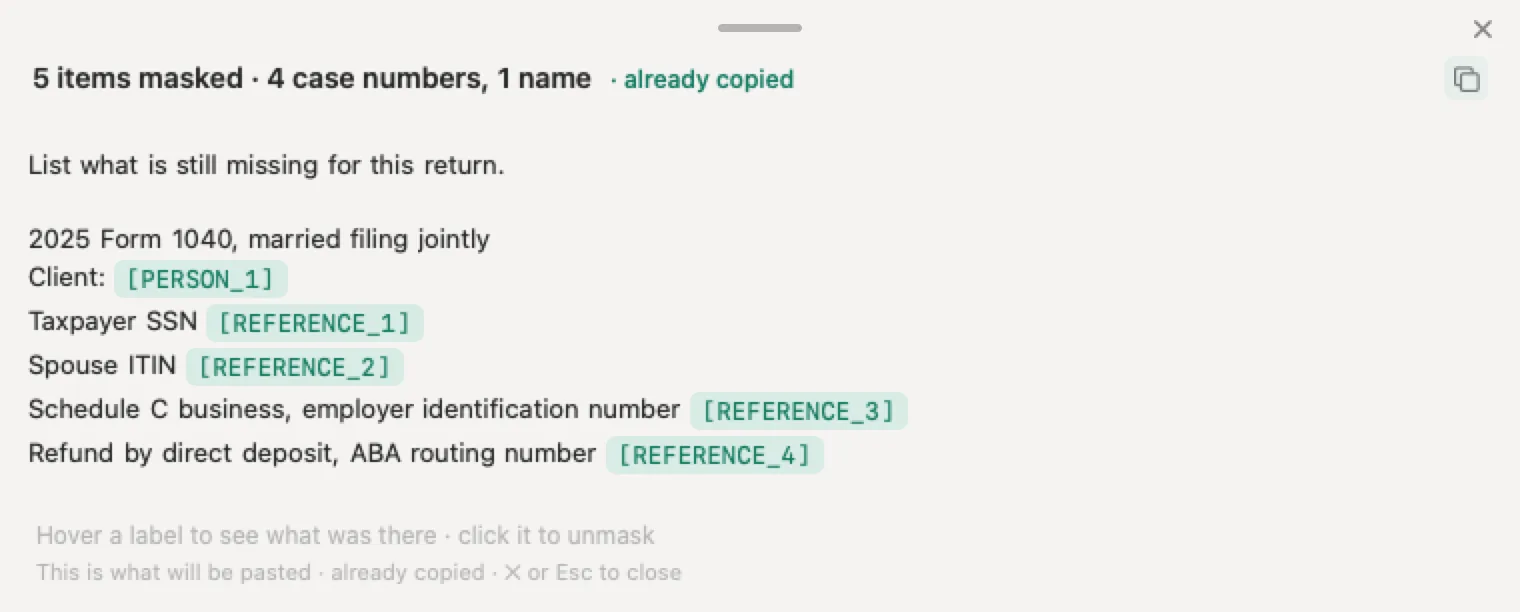
Replacing identifiers doesn’t settle that question. The regulation defines tax return information as any information furnished in connection with preparing a return. It includes statistical compilations that can’t be tied to any taxpayer. Masking the SSN shrinks what leaves the office, but it doesn’t turn the rest of the prep notes into something else. The FTC Safeguards Rule reaches the same notes by another route, set out in the accountants’ section of our redaction guide.
Business returns: the consent can sit inside the letter
For a taxpayer that does not file a Form 1040 series return, the regulation accepts a consent in any format, and names the engagement letter as one of them. The consent must name the preparer and the taxpayer. It must identify the purpose, the specific recipient and the information to be disclosed. And the taxpayer must sign and date it, all before the disclosure.
Two conditions catch firms out. First, the consent must be knowing and voluntary. Making your services conditional on it makes it involuntary, with a narrow exception for disclosures to another return preparer. Nothing from the IRS says whether an AI provider can ever fall inside that exception. Second, a new provider is a new recipient, so switching tools means a new consent.
Form 1040 clients: a separate page in the IRS’s own words
For individual filers, Rev. Proc. 2013-14 is stricter. Each consent sits on a separate written document, which the IRS says may be provided as an attachment to an engagement letter. On paper, every sheet carries only the consent, in type of at least 12 points. The mandatory statements go in the order the revenue procedure prints them, with the TIGTA complaint line. The taxpayer has to sign affirmatively, so opt out forms don’t work.
If the recipient is a preparer outside the United States, the revenue procedure adds another mandatory statement. A 1040 filer’s SSN cannot go to one without the safeguards it describes. Whether an AI provider’s overseas processing counts is, again, something the IRS has not addressed. Put the duration in the consent yourself rather than inheriting the one year default, so that renewing it becomes part of the engagement cycle.
The paragraph for a CPA engagement letter
The first card below can go in every CPA engagement letter. The second is for business clients, and it sits in the same letter. The brackets work as they do in the law firm clause: each one is a decision to make before the letter goes out.
Use of artificial intelligence tools. [Firm] may use artificial intelligence tools to assist with research, drafting correspondence and organizing documents. Our staff review everything these tools produce, and [the engagement partner] remains responsible for the work. We will not disclose your tax return information to the provider of any such tool, or use it there, except as section 7216 of the Internal Revenue Code and its regulations permit or with your separate written consent.
[Client name] authorizes [Firm name] to disclose [describe the information, for example the fiscal year 2026 trial balance and general ledger detail] to [provider name], which operates [tool name], for the purpose of [assisting in the preparation of the client's 2026 federal income tax return].
Signature, name, title and date.
For 1040 clients, the second card moves to its own page, with the revenue procedure’s wording and a line to state the duration. The first card can stay in the letter for everyone. It promises nothing beyond what the statute already requires, and it tells the client where the line is.
Five ways AI language goes wrong in a US engagement letter
Most of these come from putting a sensible idea in the wrong place. Each one is tied to the source that makes it a problem.
| The mistake | Why it fails | Source |
|---|---|---|
| 1 · Consent folded into the standard terms | Initialed on page eleven with everything else, it is the general authorization that does not produce informed consent. Give it its own paragraph and signature | ABA Formal Opinion 512 |
| 2 · One consent for every tool, indefinitely | Consent is analyzed for a particular tool, and a section 7216 consent names the specific recipient, so a new provider means a new consent. A 1040 consent that states no period lapses after one year | ABA; 26 CFR 301.7216-3; Rev. Proc. 2013-14 |
| 3 · The vendor’s marketing, restated as the firm’s promise | Reasonable efforts need more than generalized marketing assurances, and the provider has to be monitored for changes. A promise that the vendor never stores anything makes the firm answer for terms it does not control | California guidance; NYSBA report |
| 4 · A technology charge by default | A periodic charge you can’t tie to one matter is overhead, and AI costs carry no markup without informed written consent. A flat AI fee on every invoice fails both | Florida Opinion 24-1; California guidance |
| 5 · Consent as a condition of taking the matter | For a CPA, it makes a section 7216 consent involuntary, outside the narrow exception for another return preparer. For a lawyer, a client who refuses is giving an instruction that must be followed | 26 CFR 301.7216-3; California guidance |
Sources: the documents in the source list below.
And if a client’s file does reach a tool it shouldn’t have, the engagement letter is no longer the question. Our guide on client data put into ChatGPT covers what comes next.
Nonimo on the attorney’s computer, for version A
Version A commits the firm to a step before every prompt, which is only realistic if the step takes seconds. Nonimo runs on each attorney’s Mac or Windows PC. Select the passage and press its key. The client name, SSN, date of birth and other identifiers it detects are swapped, on that same machine, for labeled placeholders such as [PERSON_1], before anything goes into the chatbot.
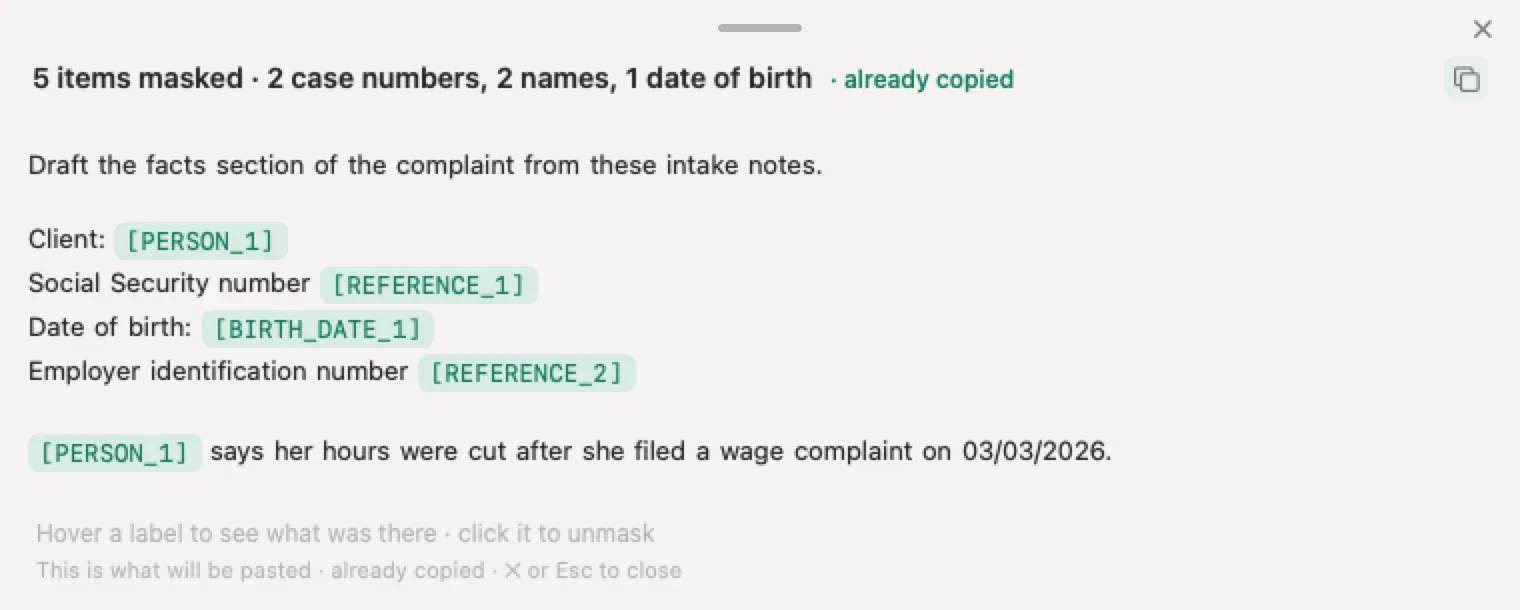
The reply comes back with placeholders, and the app writes the real details back in for the attorney. The substitution list stays on that machine, encrypted, as the security page sets out. That is the fact behind the clause’s words “computers the Firm controls.”
The app finds identifiers, not meaning. In the intake notes above, the date of the wage complaint went through as typed, and an employer plus a date can point to a plaintiff as surely as a name. Version A’s promise to review the text for context is the step that catches that.
Because the firm can reverse the placeholders, this is pseudonymization. That is why version A still tells the client that facts reach the provider. How the app fits a firm’s AI policy is on the law firm page. State rules differ, so adapt the language to each jurisdiction where the firm practices.
Sources
Each one, with the point it supports.
- ABA Standing Committee on Ethics and Professional Responsibility, Formal Opinion 512, July 29, 2024. Page 7 (informed consent before client information goes into a self learning tool; general, boilerplate engagement letter provisions not sufficient; what informed consent needs); pages 8 and 9 (Rule 1.4: disclosure when asked or required by the engagement agreement or outside counsel guidelines, when relevant to fees, and the engagement agreement as a logical place for disclosures); pages 11 to 13 (Rule 1.5: explaining the basis before charging for AI, actual time, overhead).
- ABA, Model Rule 1.6, Confidentiality of Information. Information relating to the representation, whatever its source, stays confidential absent informed consent, implied authorization or an exception. Rules 1.4(a)(1), 1.4(a)(2), 1.4(b) and 1.5(b) are quoted from Opinion 512.
- State Bar of California, COPRAC, Practical Guidance for the Use of Generative Artificial Intelligence in the Practice of Law, 2026 revision replacing the 2023 version (PDF dated May 15, 2026). Page 3 (the lawyer remains fully responsible for outputs); page 5 (no confidential information into a tool with material risks absent informed consent); page 7 (considering disclosure of intended use, following client instructions that limit AI); page 8 (fee agreements, overhead, separately billed AI costs without markup absent informed written consent).
- The Florida Bar, Ethics Opinion 24-1, January 19, 2024, read in full in the Bar’s own Ethics Informational Packet on Technology, updated November 14, 2025. Informed consent recommended before a third party generative AI program receives confidential information and not required where none is disclosed; lawyers remain responsible for their work product; informing the client, preferably in writing, before charging the actual cost of generative AI; periodic charges not prorated; advisory opinions are not binding.
- New York State Bar Association, Report and Recommendations of the Task Force on Artificial Intelligence, approved by the House of Delegates on April 6, 2024. Page 57 (consider a statement in the engagement letter and the client’s acknowledgment); page 58 (surcharges stated in the engagement letter; assurances from the provider even with consent); page 78, Appendix C (the sample provision, with nothing on client data or fees).
- Professional Ethics Committee for the State Bar of Texas, Opinion 705, February 2025. No confidential information into a tool the lawyer is not satisfied with, without client consultation and consent; considering informing clients of the risks; no hourly fees for time saved; per use expenses if the client accepts the arrangement.
- State Bar of Texas, Sample AI Disclosures for Attorney-Client Contracts, 2025. Three sample clauses; only the second addresses what client information will not be entered into a tool; none addresses fees.
- 26 CFR 301.7216-1, paragraph (b)(3). Tax return information means any information furnished in connection with preparing a return, including statistical compilations that identify no taxpayer.
- 26 CFR 301.7216-3. Written consent before any disclosure; knowing and voluntary, and involuntary if services are conditioned on it, save the exception for another return preparer; name of preparer and taxpayer, purpose, specific recipient, information, signature and date; any format, an engagement letter included, for taxpayers outside the Form 1040 series; no consent to send a 1040 filer’s SSN abroad without safeguards.
- Internal Revenue Service, Rev. Proc. 2013-14. Section 3.01 (misdemeanor, up to one year, fine up to $1,000); section 5.01 (separate written document, which may be attached to an engagement letter); section 5.02 (12 point type, text only about the consent); section 5.04 (mandatory statements, TIGTA line, one year default duration, affirmative consent, signature, statement for preparers outside the United States).
- 26 U.S.C. § 7216, subsection (a), with § 6713(b). Misdemeanor for knowing or reckless disclosure by a preparer; up to one year, a fine of up to $1,000, or $100,000 where the identity theft rule of section 6713(b) applies.
- Internal Revenue Service, Section 7216 information center, read on September 24, 2026. The regulations and revenue procedures in force; no guidance on AI tools.
Nonimo is the software that does this on your own computer: it masks client names and IDs before your text reaches ChatGPT . No account, and your client's details never leave your machine.
Common questions
What should AI disclosure language for engagement letters say?
AI disclosure language for engagement letters should cover four things: the tasks the tools help with, a lawyer's review of their output before anyone relies on it, how the client's information is handled, and how the tools affect fees. The information sentence matters most, because it decides whether you also need the client's informed consent. Nonimo supports one version of it: identifiers are swapped for placeholders on the firm's machines before a prompt is sent.
Is a clause in the engagement letter the same as the client's informed consent?
No. A notice tells the client. Informed consent asks the client, after you explain the particular tool, the information involved, the risks and the benefits. In Formal Opinion 512 the ABA said a general, boilerplate authorization in an engagement letter does not produce informed consent. If the letter is where you ask, give consent its own specific paragraph and its own signature line. Get it back before any client information goes in.
Do I have to name the AI tool in the engagement letter?
Not for the general notice. No rule asks for a product name, and naming one means amending the letter every time you switch tools. Consent is different. The ABA ties that analysis to a particular tool, so the version B paragraph names the software and its provider. A CPA relying on section 7216 consent has no choice: the regulation requires the consent to identify the specific recipient of the information.
Can the engagement letter let me bill the client for AI costs?
Yes, for costs incurred on that client's matter and disclosed in advance. California's 2026 guidance wants the fee agreement to say AI costs may be billed separately, at actual cost, with no markup unless the client gives informed written consent. Florida treats a subscription you cannot tie to one matter as overhead. Hours a tool saved are never billable time, and Texas Opinion 705 says so outright.
What about clients whose engagement letter is already signed?
Rule 1.4(a)(1) answers the timing. When something needs the client's informed consent, the lawyer has to tell the client promptly. So before information from an open matter goes into a tool the client was never told about, send the client information paragraph as a short standalone letter. For version B, add the consent block. Matters that never touch the tool can wait for the next engagement.
Can a CPA put the section 7216 consent inside the engagement letter?
Yes, for a client that does not file a Form 1040 series return. The regulation accepts any format, an engagement letter included. The consent must name the preparer, the taxpayer, the purpose, the recipient and the information, and it must be signed and dated. For individual 1040 filers, Rev. Proc. 2013-14 requires a separate document with the IRS's mandatory wording, which can travel attached to the letter.
What if the client tells us not to use AI on their matter?
Then the firm follows the instruction. California's guidance says lawyers must follow client instructions or guidelines that restrict AI. The ABA reads Rule 1.4 the same way when an engagement agreement or outside counsel guidelines call for disclosure. That is why the notice paragraph gives the client a written way to say no. A firm that cannot do a task without a tool should say so before the letter is signed.
How does Nonimo relate to version A of the clause?
Nonimo is one way to perform the step version A describes. On the attorney's Mac or PC, a key press swaps the identifiers it detects for placeholders before the prompt is sent. The reply comes back with the real details restored. It does not stop text sent without the key, does not read context and keeps no log of replacements. The review the clause promises is still the lawyer's job.