Use of AI in court documents: what you sign in England and Wales
· Updated · Written and maintained by Joaquín Trapero, Nonimo
Is there a rule on the use of AI in court documents in England and Wales? Not one that covers every document, not yet. Since 1 July 2026 the Technology and Construction Court’s own guide has told legal representatives that any doubt about mentioning AI must be resolved in favour of disclosing it.
The Upper Tribunal makes you sign that your authorities exist. The Civil Justice Council has proposed a declaration for trial witness statements, and its final report is due later in 2026.
That is the half of the question people ask about. The other half comes earlier. Every one of those documents assumes the file was handled properly before anybody opened a chatbot, and a tribunal decision and a regulator’s warning from the last twelve months say what happens when it was not. One treats ChatGPT as the public domain; the other warns that privilege given away that way cannot be recovered.
This guide takes both halves in turn: what you now sign or say to the court, and what should never have left the office before you did. It is written for solicitors and barristers in England and Wales, and it is not legal advice. Where something is only proposed, it says so. Our page for solicitors covers the practice side; the court side is set out here in full.
What has changed since 1 July 2026
There is no single rule to look up. There are six documents, and they do not carry the same weight. The easy mistake is reading them at the wrong level: guidance written for judges quoted as if it bound the parties, or a consultation proposal quoted as if it were already in the rules.
| Document | Issued by | Status | What it asks of you |
|---|---|---|---|
| TCC Guide, section 1.6 | Technology and Construction Court | Guide, from 1 July 2026 | Disclose when in doubt, verify citations |
| Judicial review claim form | Upper Tribunal (IAC) | Form amended, per [2026] UKUT 81 | Sign that each authority exists |
| Chancery Guide, paragraph 12.61 | Chancery Division | Guide, updated September 2025 | Make sure authorities are genuine |
| Interim report on court documents | Civil Justice Council | Proposal, final report later in 2026 | Declarations for witnesses and experts |
| AI guidance for judicial office holders | The judiciary, 31 October 2025 | Guidance for judges | Be ready to confirm what you checked |
| Warning notice, Misuse of AI | SRA, 17 August 2026 | Regulator’s guidance | Confidentiality and supervision |
Status as read on 23 September 2026. Each document is linked in the sources at the end.
Rule, guide or guidance: what each one weighs
The Civil Procedure Rules and their practice directions are binding procedure. Today neither contains an AI declaration. The statement of truth for experts in Practice Direction 35, for instance, has no AI wording in it.
A court guide sits below that. The TCC Guide is not a practice direction. But the court that publishes it says counsel and solicitors conducting cases there “are expected to be familiar with the Guide and to follow both its letter and spirit”. When a section of that guide uses the word must, it is the court telling you in writing what it expects.
The judicial guidance is a different animal again. It is addressed to judges, tells them how to use AI themselves, and describes what they may ask of the people in front of them. It binds nobody else, but it tells you what the judge has been told to look for. The regulator’s side, contract by contract and tool by tool, is in our checklist for choosing an AI tool.
Scotland and Northern Ireland
Everything in this guide is about the courts of England and Wales. The Court of Session and the courts in Belfast run their own procedure, and we have not found a written rule from either that asks practitioners to disclose their use of AI in court. If one exists, we would rather be told than guess. North of the border the regulator is also a different body: the Law Society of Scotland, not the SRA.
The TCC Guide: if in doubt, disclose
The fourth edition of the Technology and Construction Court Guide was published on 1 July 2026, the first since October 2022. Among the new material is a short section, 1.6, headed “The Use of Artificial Intelligence”. It has five paragraphs, and the second is a court in England and Wales telling practitioners, in writing, whether to tell the judge that AI was involved:
TCC Guide, fourth edition 2026, paragraph 1.6.2 “Whether and to what extent legal representatives should disclose their use of AI will depend on the context. However, any doubt as to whether the fact that AI has been used should be mentioned must be resolved in favour of disclosing such use.”
Read the two sentences separately. The first leaves the decision to you and does not list the contexts. The second takes the benefit of the doubt away from you. A litigator who is not sure whether to mention AI now has a court telling them which way to fall, which is not where most firms stood a year ago.
What the paragraph does not settle
The guide does not say where the mention goes, what form it takes or how much detail it needs. It does not distinguish research from drafting, or a first draft from a final polish. We will not invent an answer the court has not given. What it settles is the default, and in a court where the default is disclosure, the safe practice is to decide on each document and write the decision down.
Four paragraphs, and one of them is about confidentiality
Paragraph 1.6.1 puts responsibility on the representative for everything placed before the court and says that, with that in mind, AI can be used. Paragraph 1.6.4 requires independent verification of any research or citations produced with its help, and says the representative “must be in a position to confirm” having done it. Paragraph 1.6.5 points to the judicial guidance.
Paragraph 1.6.3 is the one most summaries skip. It says legal representatives “must at all times uphold the confidentiality of and protect the privacy of any underlying data in relation to which Artificial Intelligence is used”.
The underlying data is the file: the pleadings, the correspondence, the expert’s notes. The court has put the question of what goes into the tool in the same section as the question of what you tell the judge. Our guide to cleaning a client file covers what taking names out achieves and what it leaves behind.
Disclosure, where AI is not new
The TCC is also the court where machine help with documents has the longest history. The CJC’s report notes that it was the first court to develop a protocol for electronic disclosure, and that the courts accepted technology assisted review from Pyrrho Investments v MWB in 2016.
On disclosure lists and statements, the CJC saw no pressing case for an AI statement, though it flagged a harder question for later: whether prompts, and the documents they were tested on, may one day have to be disclosed too.
The Upper Tribunal’s statement of truth on authorities
The Upper Tribunal reached for a signature earlier, and it did so because of volume. In UK and Munir, promulgated on 17 November 2025 and reported as [2026] UKUT 81 (IAC), the tribunal recorded a considerable increase in the second half of 2025 in citations of cases that do not exist, in both appeals and judicial review claims.
Its response was to change the claim form. As paragraph 9 of the decision explains, a legal representative starting a judicial review in the Upper Tribunal must now confirm by a statement of truth that every authority cited in the form or its attachments exists, can be found from the citation given, and supports the proposition it is cited for. The tribunal added that other forms and directions would be amended in the same way.
Every authority cited in the form or its attachments is a real one.
The citation given leads to it.
It says what it is cited for.
What the signature covers, and who carries it
Notice what the statement does not ask. It does not ask whether AI was used. It asks whether the citations are real and right, which is a question you answer the same way whether a trainee, a textbook or a chatbot produced the list. The tribunal said as much: whether errors are “inserted by a hapless trainee or by ChatGPT is really neither here nor there”.
The consequence is stated plainly. A representative who signs the statement in a case where false authorities are cited “should ordinarily expect” a referral to their regulator. The decision also puts weight on supervision: a supervisor who fails to catch a junior’s false citation is likely to be more culpable than a lawyer who fails to catch their own. Munir was an immigration case; our page for solicitors looks at what an immigration file carries.
Witness statements: the declaration the CJC has proposed
The Civil Justice Council set up a working group in January 2025, chaired by Lord Justice Birss, to ask whether rules are needed on the use of AI by legal representatives in preparing court documents. Its interim report and consultation, published in February 2026, answered with a series of proposals. The sharpest of them are about evidence: what a witness says, and what an expert concludes.
The wording floated for witnesses is wide. The legal representative would declare that AI had not been used to generate the content of the statement, “including by way of altering, embellishing, strengthening, diluting or rephrasing the witness’s evidence”. Which rule each proposal would change is set out below.
| Document | Rule the CJC would amend | What would be declared |
|---|---|---|
| Trial witness statement, Business and Property Courts | PD 57AC | AI not used to generate the content |
| Trial witness statement, other civil courts | Part 32 | The same, beside the statement of truth |
| Expert report | PD 35, paragraph 3.3 | Any use of AI explained, and the tools named |
Civil Justice Council interim report, February 2026, paragraphs 7.15, 7.16 and 8.2. Proposals only.
What the proposal leaves out
The report is careful to separate uses. Administrative help, such as transcription or spell checking, would not need a declaration. The line it draws is generation: AI producing or reshaping the words that go before the court as the witness’s evidence. That is narrower than any use of AI at all, and it rests on an old principle: Part 32 and PD 57AC both want the witness’s own words.
Where it stands after the consultation
In its June 2026 update, the CJC reported strong agreement that pleadings, skeleton arguments and similar documents need no new AI rules, because professional responsibility already covers them. Witness statements were the open question, with respondents divided on whether a disclosure requirement would help or complicate matters, and whether statements of truth and cross-examination already do the job. The final report is due later in 2026; until a rule is made, there is nothing to sign.
Godwin v Godwin: a “digital assistant” in Leeds
A court does not need the declaration to ask the question. In Godwin v Godwin, [2026] EWHC 923 (Ch), decided on 22 April 2026, HHJ Klein had two witness statements whose authors said they had had “limited assistance” from a “digital assistant” for grammar, spelling and presentation. The assistant was ChatGPT. Both said it had not added, removed or rearranged a word.
The judge found no good reason to use it: both witnesses were capable of using the spelling and grammar check in their word processor. He noted that calling ChatGPT a digital assistant was not conventional English, and could not rule out that the phrase came from ChatGPT itself, or that the defendant was trying to obscure his use of it.
Without the first drafts, he could not be sure the statements were in the witnesses’ own words, and approached their evidence cautiously.
There is a second point in the facts that the judgment did not need to decide. Both drafts were uploaded to ChatGPT to be polished, and a statement in a dispute over an estate carries family names, homes and money. How long OpenAI holds a conversation like that, and who can read it, is covered in our ChatGPT guide for UK users.
Expert reports and the statement of truth in Practice Direction 35
Experts already sign one, in the form paragraph 3.3 prescribes. It confirms which facts are within their own knowledge and that the opinions are their true and complete professional opinions. It says nothing about AI.
The CJC’s reasoning for changing it differs from its reasoning on witnesses. An expert, unlike a witness, may properly rely on material produced by AI, provided the use is identified and explained, so the proposal is a duty to explain rather than a promise not to use it. It cites a Bond Solon survey of 525 expert witnesses, published on 7 November 2025, in which 20% said they had used AI in that role.
What an instructing solicitor can do before any rule
The June update named “proportionate transparency” in expert evidence as the direction of travel. It is the only evidence proposal the update describes in those terms. Nothing stops you asking now.
An expert instructed on a personal injury claim may be working from medical records, and the question of which chatbot has seen them is yours as much as theirs. If the answer is Claude, our guide to what Claude keeps sets out Anthropic’s terms on training and retention.
Citations and skeletons: check, and be ready to say you did
The judgment the profession still quotes is Ayinde v Haringey, decided by a Divisional Court on 6 June 2025 and heard with Al-Haroun under the court’s Hamid jurisdiction. The court, with Dame Victoria Sharp, President of the King’s Bench Division, presiding, said at paragraph 6 that freely available generative AI tools such as ChatGPT “are not capable of conducting reliable legal research”. In both cases the court referred the lawyers concerned to their regulators.
Two court guides now say it in writing. The Chancery Guide, in its update of September 2025, added to paragraph 12.61 a line telling parties who use online resources, AI included, to research authorities to be careful that the authorities they rely on are genuine. The TCC Guide’s paragraph 1.6.4 goes further and asks you to be in a position to confirm that you checked.
Why the CJC resisted a declaration for pleadings
The interim report explains its reluctance in terms any litigator will recognise. AI is becoming so embedded in ordinary legal software that it may soon be hard to tell when it was used at all. A statement that goes beyond taking professional responsibility for a document, the working group feared, might prompt more questions from the court and add to delays. The name of the responsible representative on the document is what it wants instead.
The judges’ guidance and the TCC do not say the same thing
The AI guidance for judicial office holders, updated on 31 October 2025, contains a sentence that sits uneasily beside the TCC Guide: “Provided AI is used responsibly, there is no reason why a legal representative ought to refer to its use, but this is dependent upon context.” It also says judges may need to remind lawyers of their obligations and ask them to confirm they verified any research carried out with AI.
The two can be reconciled: both hang on context. But they start from opposite ends. The judges’ guidance treats silence as normal and asks for confirmation when needed; the TCC treats disclosure as the answer when in doubt. For pleadings and skeletons the CJC update says no new rule is needed. A firm that wants one answer across every court can write it into its AI policy.
| Judges’ AI guidance | TCC Guide, section 1.6 | CJC on pleadings and skeletons | |
|---|---|---|---|
| Starting point | Silence is normal | Disclose if in doubt | Professional responsibility covers it |
| When to mention AI | Depends on context | Depends on context; disclose when unsure | No new rule needed |
| What you may be asked | To confirm you verified AI research | To confirm you checked research and citations | Your name on the document as the responsible representative |
Judicial guidance of 31 October 2025, TCC Guide of 1 July 2026, CJC interim report of February 2026 and update of June 2026.
What must not leave the firm before anything is signed
Every document described so far looks at what comes out of the tool: whether the words are the witness’s, whether the cases are real. The decision that looked at what went in came from the same tribunal. In UK and Munir, at paragraph 21, the Upper Tribunal said this:
Upper Tribunal (IAC), UK and Munir, [2026] UKUT 81, paragraph 21 “to put client letters and decision letters from the Home Office into an open source AI tool, such as ChatGPT, is to place this information on the internet in the public domain, and thus to breach client confidentiality and waive legal privilege”
The same paragraph goes on to say that a regulated firm that does so would need to tell its regulator and would be advised to consult the Information Commissioner, and the headnote is firmer still: such conduct should in any event be referred to the ICO. The paragraph also names Microsoft Copilot as an example of a closed tool available for summarising without those risks, a claim worth reading beside our Copilot guide for confidential work.
Privilege does not come back
The SRA took the decision up on 17 August 2026, in its warning notice, and the phrase that should stop a litigator in their tracks is its reference to “the permanent waiver of privilege that can occur as a result”. Privilege waived over a document that later matters in the litigation is a loss the other side can use.
The notice does not stop at free tools. It says paid services may lack the safeguards too, and asks firms to satisfy themselves that client data stays in a secure environment, is not used for training without authority, and is not kept longer than needed. Our guide to what a client file still says after cleaning sets out the three kinds of safeguard the notice expects.
The declarations do not ask about this
This is the gap in the whole structure. The TCC paragraph on disclosure, the Upper Tribunal’s statement of truth and the CJC’s proposed declarations all concern the output. None asks the signatory what went into the tool on the way. That question is answered earlier, at a desk, by whoever pasted the passage, and nobody signs for it. Among the court guides, only paragraph 1.6.3 of the TCC Guide reaches it.
Before you file: a checklist for AI in court documents
None of this needs a new system. It needs the same questions asked of every document before it goes to court, in an order that catches the confidentiality point before it is too late to fix.
- Find the court’s own guide. Check whether it has anything on AI: the TCC Guide at section 1.6, the Chancery Guide at paragraph 12.61, and any form, like the Upper Tribunal’s, that now carries its own statement.
- Say what the tool actually did. Research, summarising disclosure, a first draft of a skeleton and a polish of a witness statement are four different answers to the court. Put the answer in a file note.
- Keep the witness’s words the witness’s. Part 32 and PD 57AC already demand it. After Godwin, keep the drafts that show where the words came from.
- Check every authority against a real source. The report, the neutral citation, the paragraph. Be able to say you did, because in the TCC and the Upper Tribunal you may have to.
- Ask your experts now. Which tools, for what, and whether your client’s records went into any of them. The PD 35 change is the proposal with the clearest direction behind it.
- Look at what went in, not only at what came out. A passage with the client’s identity, the other side’s details or privileged advice should not reach a general chatbot as it stands.
- Write the rule down once. A firm policy that answers these questions for every fee earner is easier to defend than a decision taken afresh at 6pm before a filing deadline.
The sixth point is the one the courts cannot check for you. It is also the one where a tool on the sender’s own desk can help, which is what the next section is about. For the written policy in point seven, our AI policy template gives you a first draft to work from.
Where Nonimo fits, and where it does not
Nonimo runs on the desktop, on Mac and on Windows. You highlight a passage, press one key, and the client details it recognises are replaced with placeholders on your own computer before the text goes to ChatGPT, Claude or Copilot. When the answer comes back, the app puts the real details in again, because the key to the placeholders never leaves the machine.
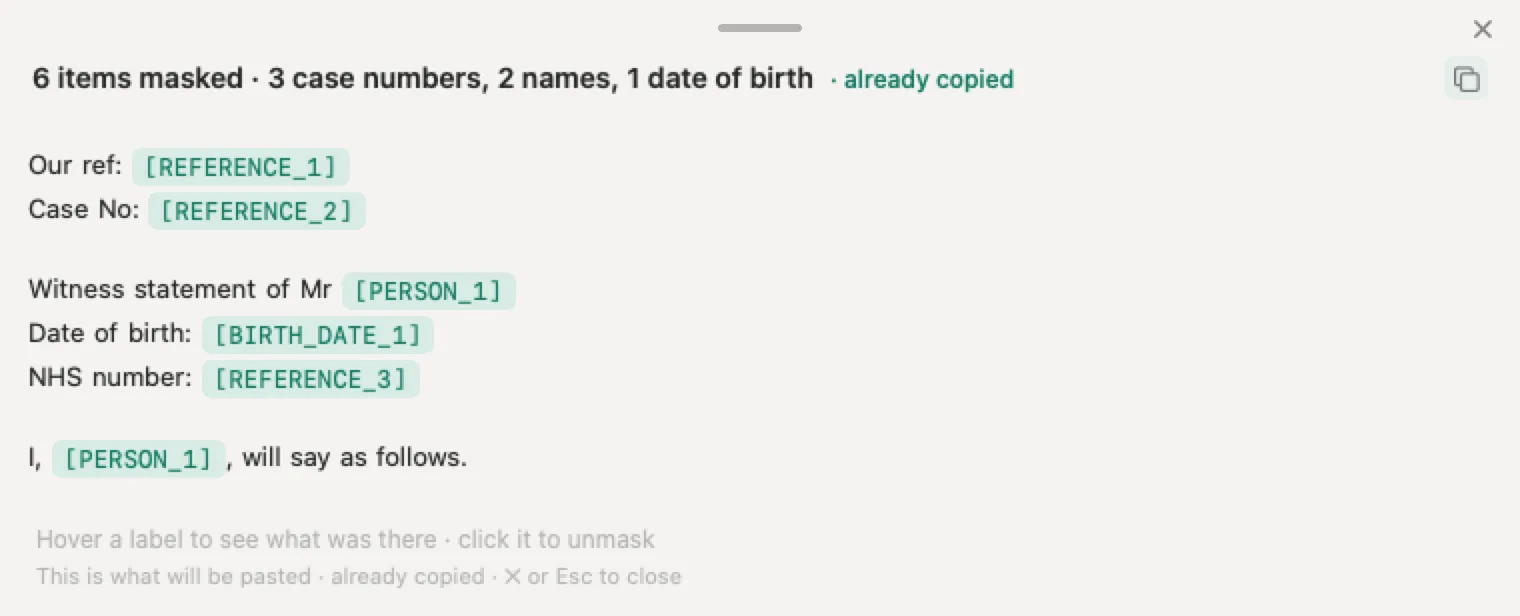
For the practice side, our page for solicitors shows the same witness statement before and after.
In a litigation practice the passages that reach a chatbot are rarely the court document itself. Far more often they are the bundle someone wants summarised, the chronology built from correspondence, the first letter to the other side, the client email that needs translating. Those carry the identifiers, and those are where the key press belongs. In a tribunal or asylum bundle they also carry health, belief or union details, which keep their category after the key press.
It is one practical step towards paragraph 1.6.3 of the TCC Guide, not an answer to it. A passage with every identifier replaced can still point to the client for a reader who knows the dispute, and the facts themselves may be confidential. Nonimo narrows what the provider receives; what the passage still says is for the person sending it to judge.
What the app keeps on your computer is set out on Nonimo’s security page.
Sources
- Technology and Construction Court Guide, fourth edition 2026, section 1.6, paragraphs 1.6.1 to 1.6.5: responsibility, disclosure when in doubt, confidentiality of underlying data, verification.
- Courts and Tribunals Judiciary, TCC Guide 2026, 1 July 2026: publication date, previous edition October 2022, and the expectation that counsel and solicitors follow the Guide’s letter and spirit.
- UK and R (Munir) v Secretary of State for the Home Department, [2026] UKUT 81 (IAC), promulgated 17 November 2025: the rise in false citations (paragraph 8), the amended claim form (paragraph 9), “hapless trainee or by ChatGPT” (paragraph 37), ChatGPT as the public domain and Copilot (paragraph 21), headnotes 2 to 4.
- Civil Justice Council, Use of AI for Preparing Court Documents: Interim Report and Consultation, February 2026: administrative uses excluded (1.4), PD 57AC and Part 32 declarations (7.15, 7.16), experts and PD 35 (8.1, 8.2), Bond Solon survey figures.
- Civil Justice Council, Use of AI in preparing court documents: working group set up January 2025, chaired by Lord Justice Birss; June 2026 update on responses; final report expected later in 2026.
- Godwin v Godwin, [2026] EWHC 923 (Ch), 22 April 2026, HHJ Klein: paragraphs 44 to 48 on ChatGPT and the witnesses’ own words.
- R (Ayinde) v London Borough of Haringey, [2025] EWHC 1383 (Admin), 6 June 2025: paragraph 6 on generative AI and legal research.
- Chancery Guide 2022, fifth update September 2025, paragraph 12.61: authorities researched with AI must be genuine.
- Artificial Intelligence (AI): Guidance for Judicial Office Holders, 31 October 2025: no reason to refer to responsible use, dependent on context; judges may ask for confirmation of verification.
- Civil Procedure Rules, Practice Direction 35, paragraph 3.3: the expert’s statement of truth as it stands.
- SRA, warning notice Misuse of AI, 17 August 2026: paid and free tools, the three conditions for client data, and the permanent waiver of privilege.
Nonimo is the software that does this on your own computer: it masks client names and IDs before your text reaches ChatGPT . No account, and your client's details never leave your machine.
Common questions
Is there a rule on the use of AI in court documents in England and Wales?
Not yet one that covers every document. The Civil Procedure Rules contain no AI declaration today. The Technology and Construction Court Guide, in force since 1 July 2026, says any doubt about mentioning AI must be resolved in favour of disclosing it, and the Upper Tribunal makes representatives sign that their authorities exist. Nonimo deals with an earlier question: which client details reach the AI tool at all.
Must I tell the court that I used ChatGPT?
It depends on the court and the document. The TCC Guide leaves it to context but tells you to disclose when unsure. The judges' own AI guidance of October 2025 says there is no reason to mention responsible use, again depending on context. Read the guide of the court you are in. Nonimo will not answer that for you; it only changes what the tool receives.
Can a witness statement be drafted with AI?
Treat it as a no for anything that shapes the evidence. Witness statements must be in the witness's own words, and in Godwin v Godwin, decided in Leeds on 22 April 2026, the judge approached two statements cautiously because ChatGPT had been used to polish them. The CJC has proposed a formal declaration on top. Nonimo does not change this: covering names says nothing about who wrote the words.
What has the Civil Justice Council proposed?
Its interim report of February 2026 proposed that trial witness statements carry a declaration that AI was not used to generate their content, and that experts explain any use of AI beyond transcription in their reports. After consultation, its June 2026 update left witness statements open and pointed towards proportionate transparency for experts. A final report is expected later in 2026. None of it is in force yet.
Does putting a client file into ChatGPT waive privilege?
The Upper Tribunal said so in UK and Munir, promulgated on 17 November 2025: client letters fed into an open source tool such as ChatGPT end up in the public domain, which breaches confidentiality and waives privilege. The SRA repeated the point in August 2026. Nonimo takes identifiers out of a passage before it is sent; it does not make privileged content safe to share.
What does the Upper Tribunal's statement of truth cover?
Authorities, not AI as such. According to the tribunal's decision in UK and Munir, the judicial review claim form now makes the legal representative confirm that every authority cited exists, can be found from the citation given, and supports the proposition it is cited for. Signing it over a false case should ordinarily lead to a referral. Nonimo checks no citations; that stays with the person who signs.
Do experts have to disclose their use of AI?
Not under the current rules. The statement of truth in paragraph 3.3 of Practice Direction 35 has no AI wording today. The CJC proposed adding a requirement that experts explain their use of AI and name the tools, and its June 2026 update described proportionate transparency as the direction of travel. Nonimo is relevant only if the expert puts your client's records into a chatbot.
Does any of this apply in Scotland or Northern Ireland?
The rules described here are for England and Wales. We have not found a written rule from the Court of Session or the Northern Ireland courts asking practitioners to disclose AI use, and we would rather say that than guess. The confidentiality point travels anywhere, because it is about what leaves the office. Wherever you practise in the UK, Nonimo works the same way.